Madeira 2010, day 5b, a few pictures

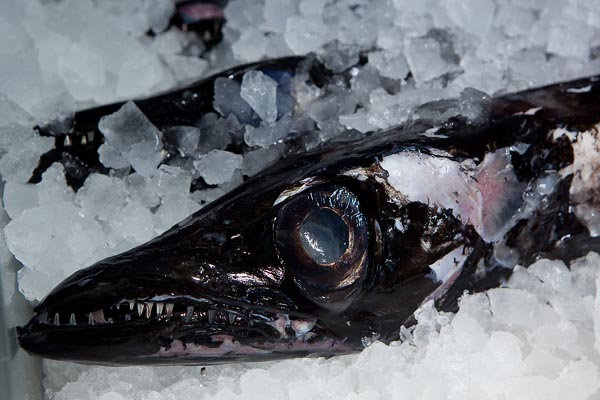
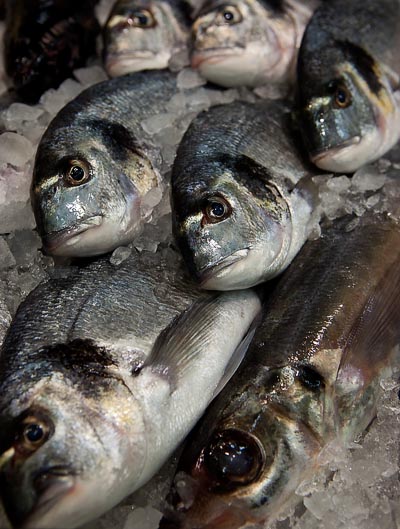
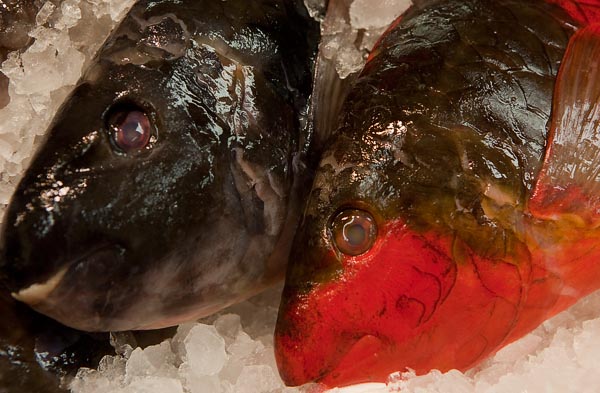
April 14 II. A few pictures from the fish department in the supermarket in Calheta. Fish is a common dish on Madeira. Don’t leave the island without having tried some form of the espada fish.

Am I mistaken or do I spot a slight smile here?

The espada is a really ugly fish. But tasty. I’ll write more about it in a future blog.

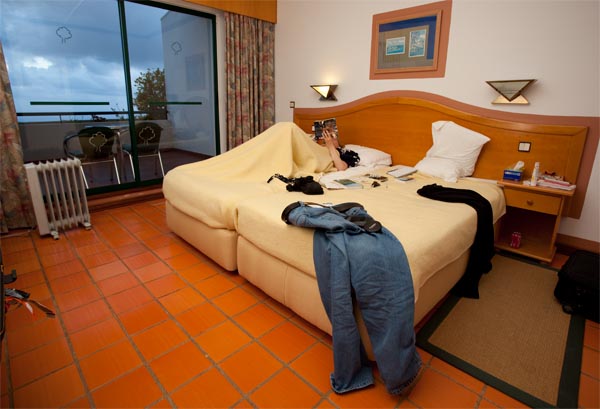
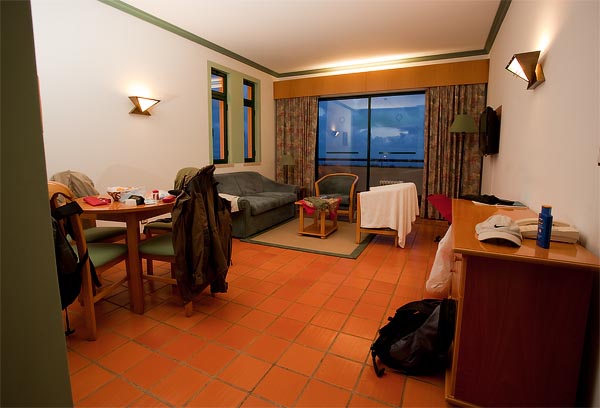
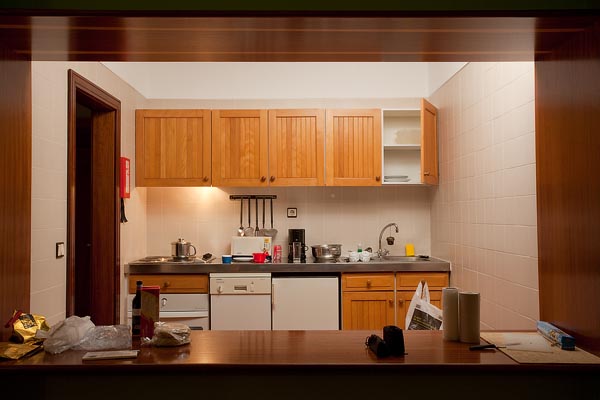
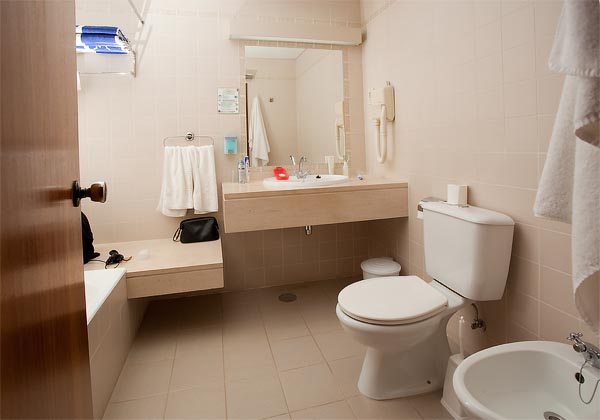
A few pictures from our nice apartment at the Jardim Atlantico hotel. Bedroom, livingroom, kitchen section and a bathroom. A wide view of the Atlantic Ocean and at the moment a dramatically cloudy sky.

Madeira 2010, day 5, a visit in the sugar cane factory in Calheta

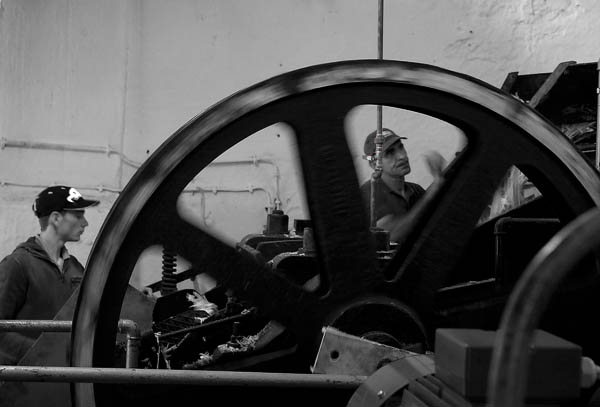
April 14 I. No walk today. We drove to Calheta instead, a small town on the south coast, not far from our hotel. The main goal was to visit the sugar cane factory. The sugar cane industry is a small but still rather important part of Madeira’s economy. The most important products from sugar canes are sugar (surprised?), sugar cane honey, molasses and rum. The process uses machinery that is all but antique, but it is still as efficient as when it was new (although the steam engines were replaced with electrical ones not too long ago). The factory is open for tourists, you can simply walk right in and stroll about. A tip we would have liked to have had before we got there: Bring ear plugs! The cane crushing machines produce a hellish noise and tinnitus must be common among the workers. None of the men in the factory were wearing hearing protection as far as we could see.

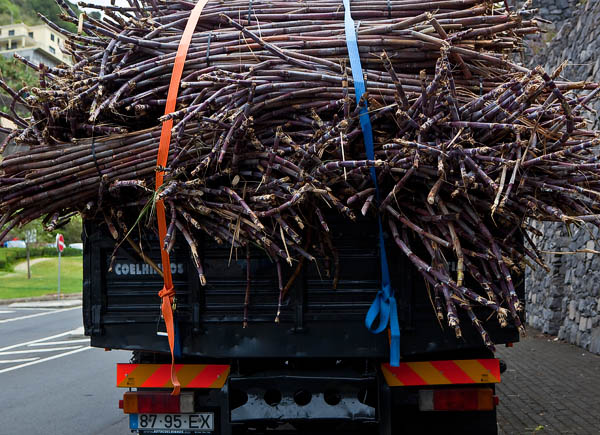
Outside the factory there are lines of trucks with huge loads of sugar canes.

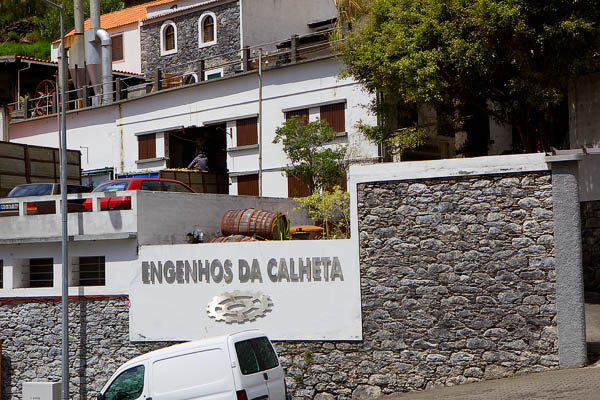
The sugar cane factory in Calheta.

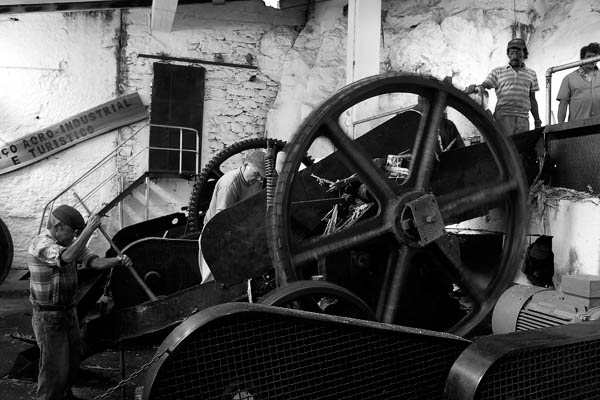
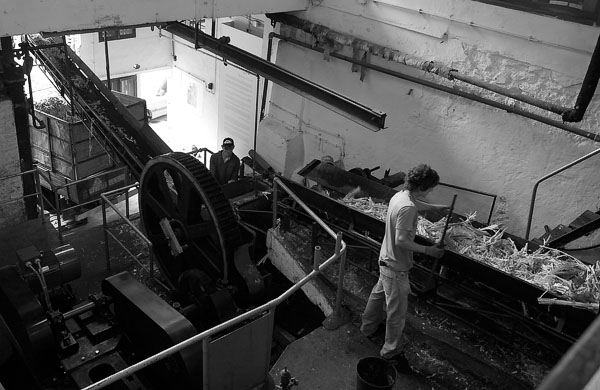
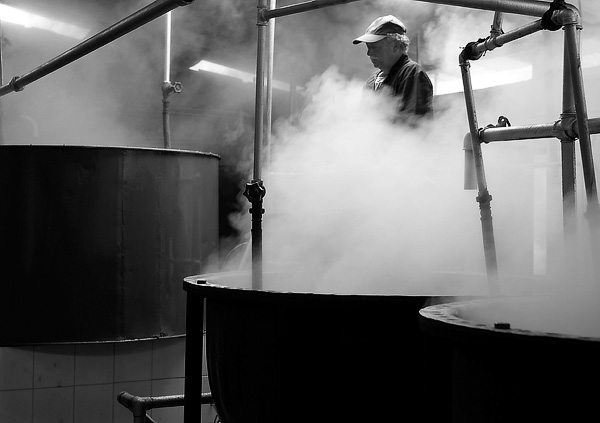
View from inside the factory with stacks of sugar canes. You can see the crushing machines in the back. I switched to black and white, it seems to work much better on this kind of images.

Only one of the machines were running, but the noise was far beyond what any human ear could stand. The machines are mostly open and occupational safety doesn’t seem to be a buzzword around here.

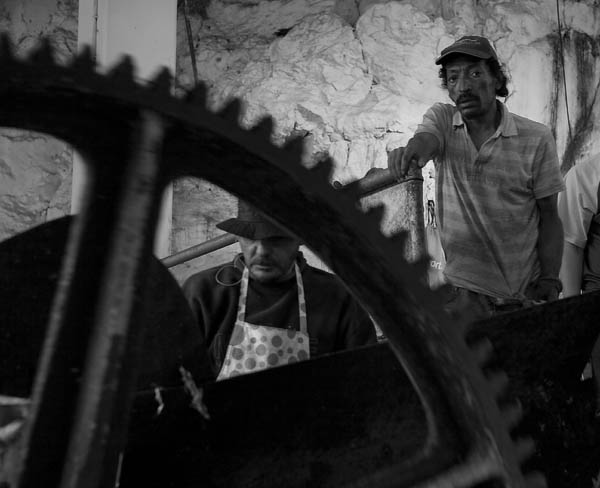
A couple of pictures of the workers.

The crushed sugare canes are transported to another machine that squeezes out even more juice. After that they end up on a lorry outside the doors (maybe to be used like this?).

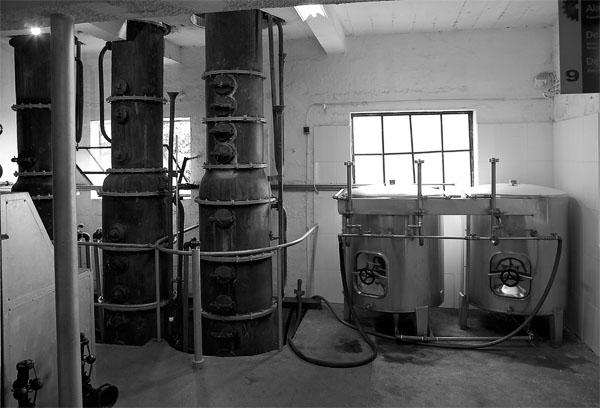
Boilers for evaporation.

Here the juice is boiled for production of sugar.

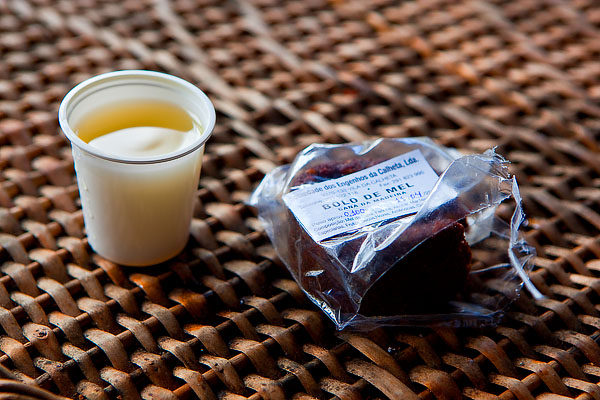
In the factory there is a small museum and a shop where you can buy sugar cane juice, rum and bolo de mel, the sweet tasting soft cake in which sugar cane honey is an important ingredience. Gunilla invested in a bottle of really nice rum (which of course caused problem at the airport, it’s easy to forget the liquid rule). We tasted some juice along with a fresh piece of bolo de mel. I thought the juice would taste like liquid sugar, but it was a fresh and fruity drink, cool in the heat.

Madeira 2010, day 4, Levada da Serra

April 13. This would prove to be the only day with bad weather during a levada walk. Certainly, the bad weather stayed in the mountains, but alas, so did we.

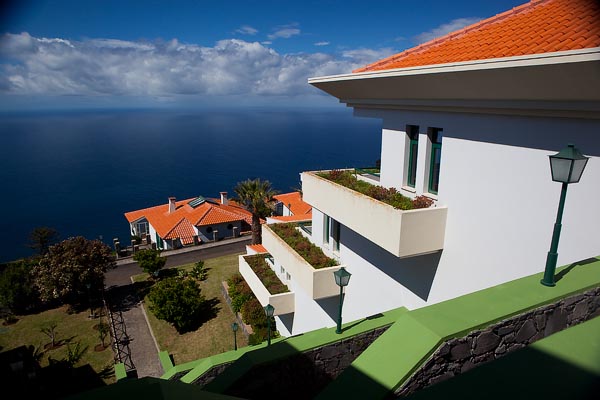
The beginning of the day was beautiful, here the sun is shining above our hotel. Our terass is the one on the second floor. We really find no reason to complain about the view. Hotel Jardim Atlântico is situated quite a distance from Funchal, out on the countryside of which most of Madeira consists. A few meters out of the hotel area you find yourself in an ordinary Madeiran village. This was the second time we chose this hotel, and if and when we get here again we will choose the same one. Last time we stayed in Funchal, but a city is a city whereever you go. If you want trecking and nature, we strongly recommend a rental car and hotel Jardim Atlântico. Here is a link to the hotel website.

The hotel is situated almost 500 meters above the ocean, and if you are up for it you can make the first walk from the hotel down to Paúl do Mar, the little port village at the bottom of the cliff. It’s a beautiful albeit laborious trip, especially if you walk up again (instead of taking a taxi).
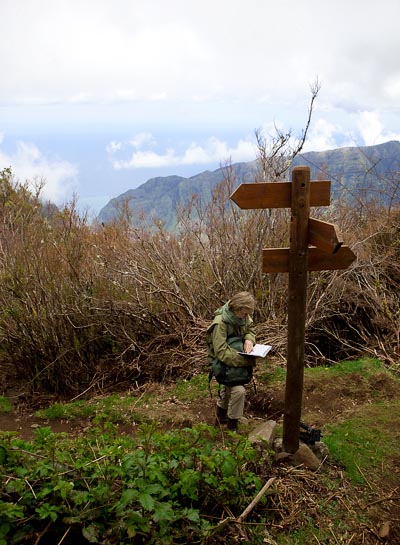
The levada we chose for today is called Levada da Serra. It runs on the northern side of Paul da Serra, the large plateau in the middle of west Madeira. Here you can see the actual birth of a levada. In this picture we have descended from where we parked our car and there is a little bit left to walk before entering the levada. We came from the path to the left, by which you can reach Bica da Cana, a peak whith one the most spectacular view on Madeira.
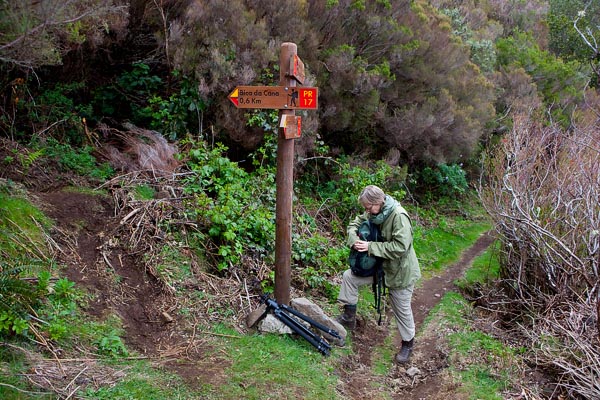
Gunilla is studying our levada bible, Vandra på Madeira (Walking in Madeira) by Anita och Birger Løvland, unfortunately not available in English (as far as we know). Clouds have gathered some hundred meters above us, but as you can see, down by the coast the sun is shining.
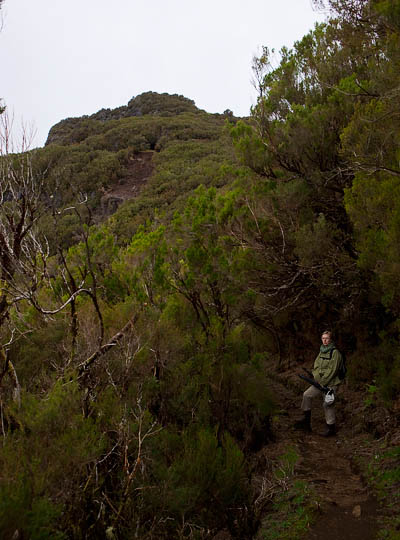
The heather trees are typical for the area, and this type of vegetation is to be found only here and on the Canary Islands. It changes the path in places to dark green tunnels.
Here are the two very first meters of Levada da Serra, at first just fed by a few tiny trickles of water.
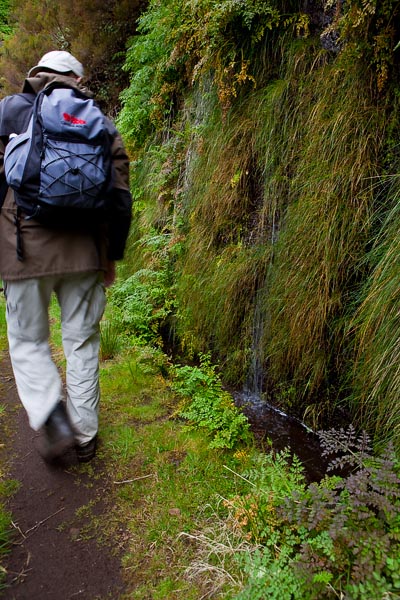
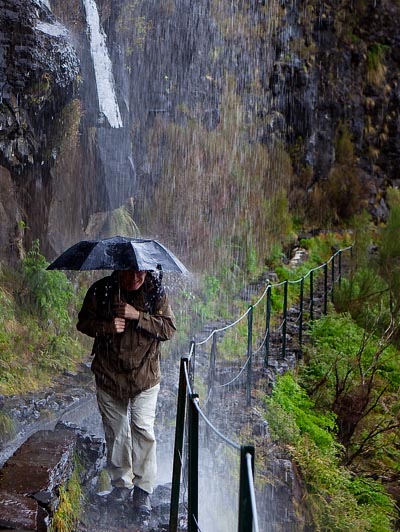
With perfect accuracy a small waterfall is falling onto the levada. It hasn’t yet started to rain, but the umbrella came in handy nevertheless.
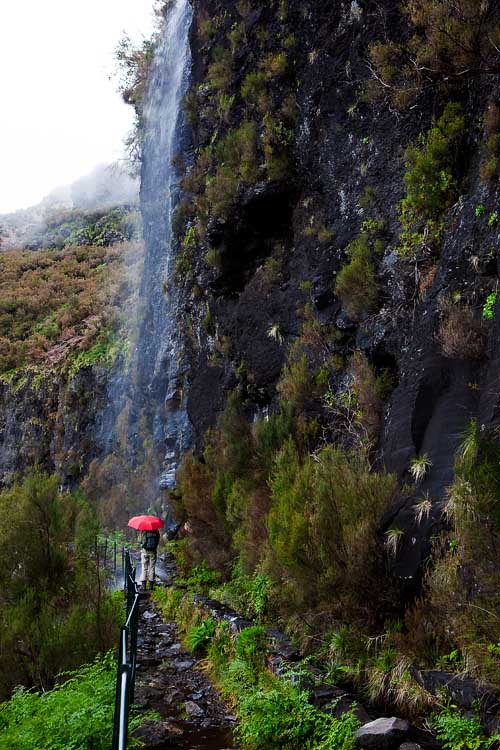
And here am I.
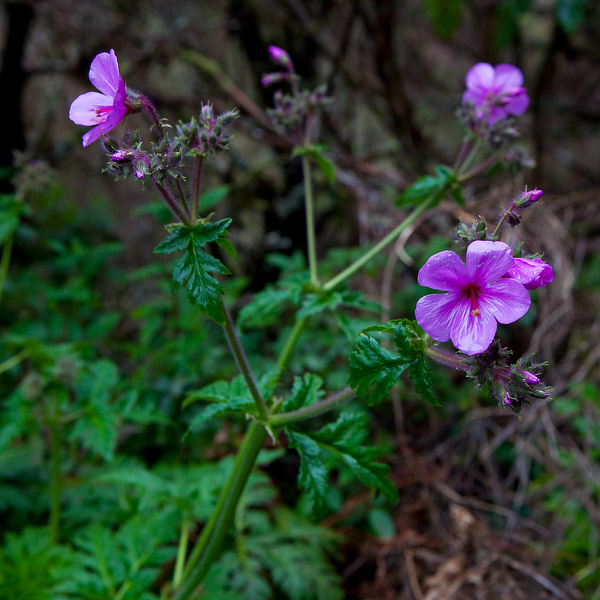
Some plants I seem to recognise from home. This looks like common wood crane’s-bill, but then again, it doesn’t. Some kind of crane’s-bill at any rate.
We had our packed lunch at a beautiful place where the levada runs down in a steep drop to a lower level. When we had finished it started to rain. We had planned to go back a little bit and then take a shortcut on a path that was supposed to lead up over the mountain. We didn’t find it and we think that it had been swept away buy one of many landslides, so we had to go all the way back in pouring rain. We came back to the hotel soaking wet, but there the sun was shining, and altogether, it had been a nice day’s walk.
Madeira 2010, day 3, Levada da Janela

April 12. Levada da Janela is our favourite levada and a must if you happen to be in Porto Moniz. It’s an easy walk, at least at the beginning, and you will be rewarded with breath-taking views all along the way. Ribeira da Janela runs in the bottom of the valley. We made the nice walk twice during this Madeira visit.

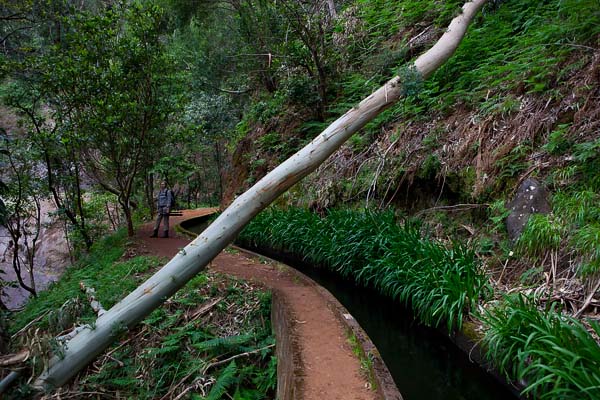
Here too you will see the results from the excessive rain during the spring in the form of landslides and fallen trees. It is not as extensive as on the south side of the island, though. Here a eucalyptus tree has yielded to the loosened soil  and fallen across the levada.

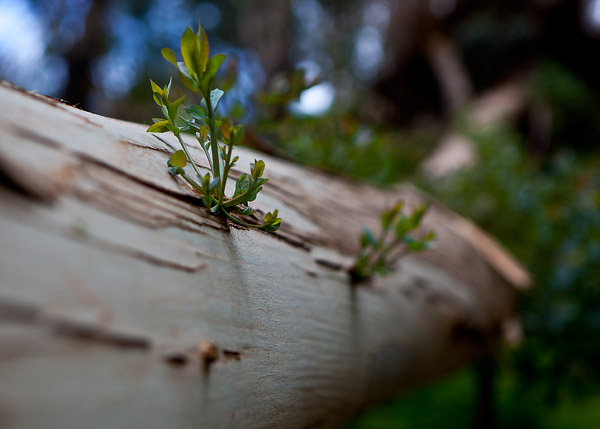
It has not yet given in though. There are fresh sprouts all over the bare trunk.
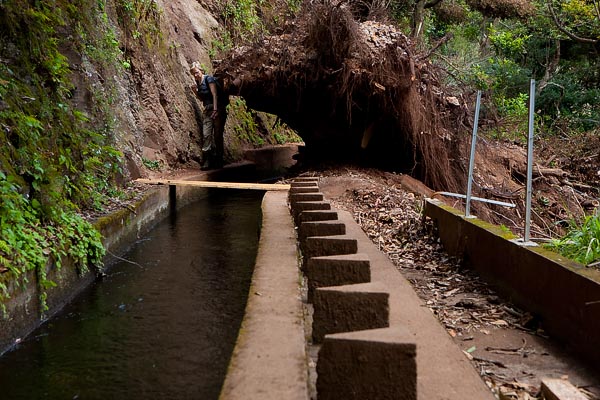
Here a whole root system has  slid down with trees and everything and laid down across the levada. The trees are removed, but the rest seems to be to difficult to get rid of. The section with the triangles in the foreground is a part of the levada wall that is a little lower than the rest. Its purpose is to control where water should overflow in case of flooding. The triangles makes it possible to pass the section when it is flooded.
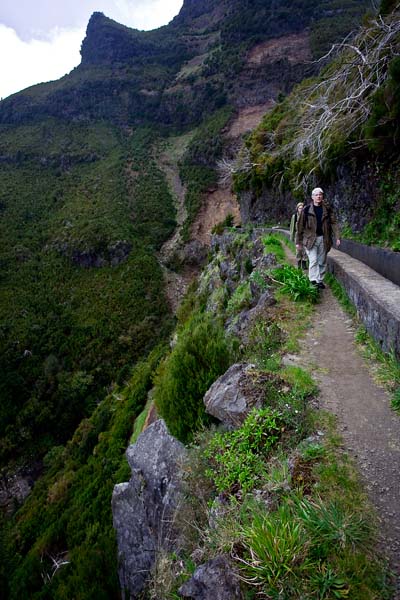
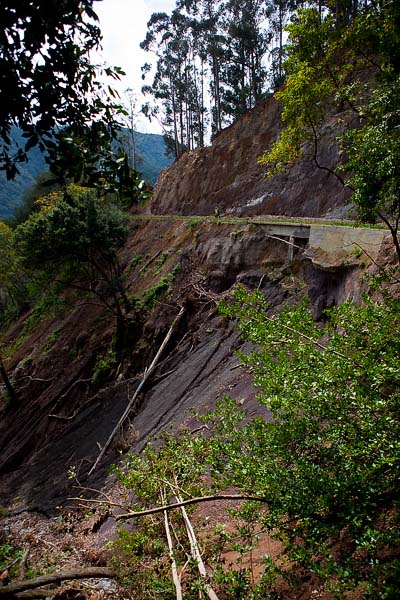
Part of the slope has slid down and the levada has been moved inwards. There is a hiker in the middle of the picture who might give you an idea of the proportions.

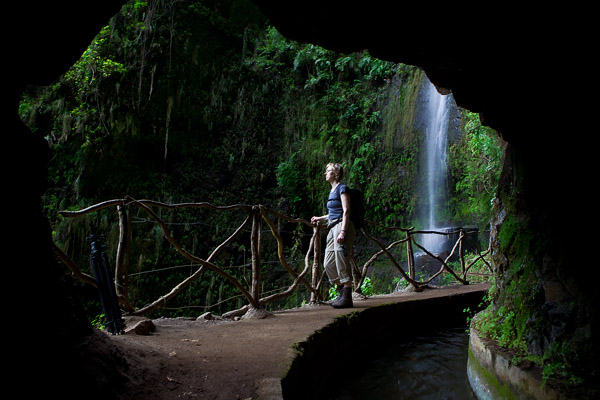
Here we have just passed the first tunnel and ended up in a ravine on the other side with a nice waterfall.

We continue towards the waterfall.

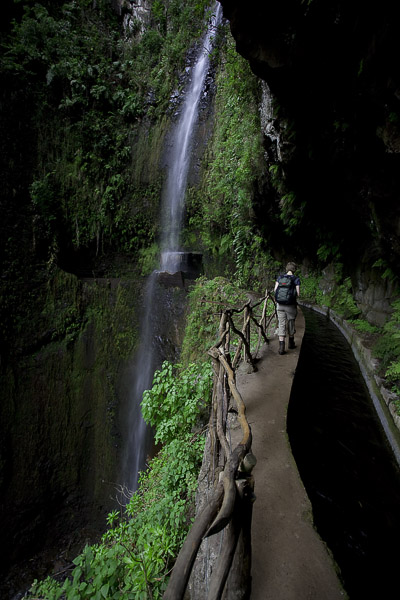
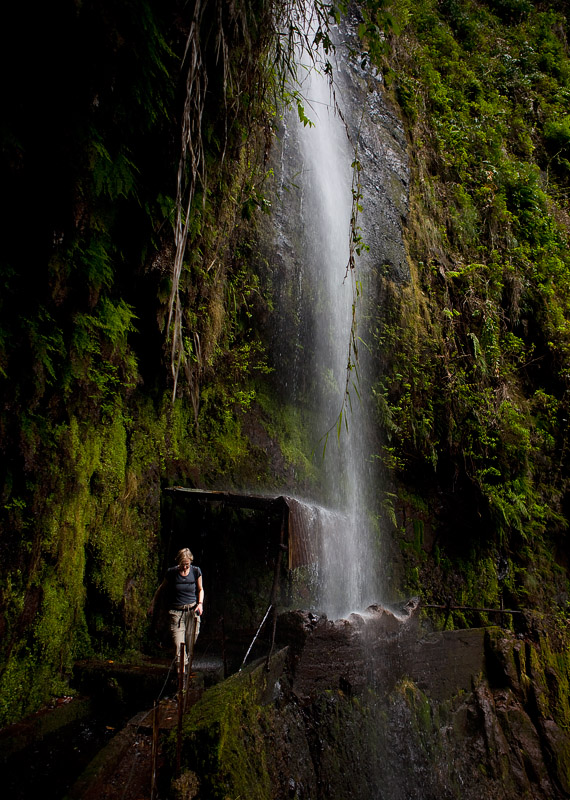
The levadeiros have built a shelter that gives you some protection against the water. We are very greatful for it.

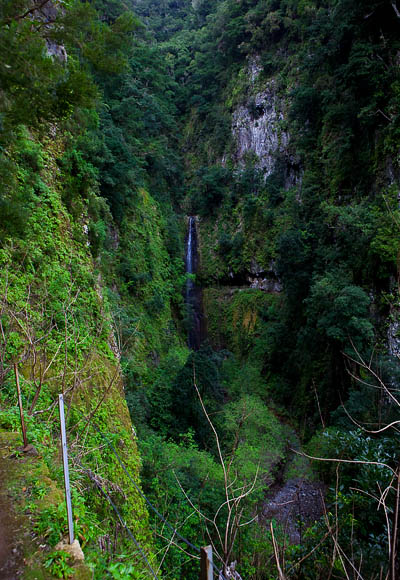
Here you can see the waterfall and the ravine from a distance.

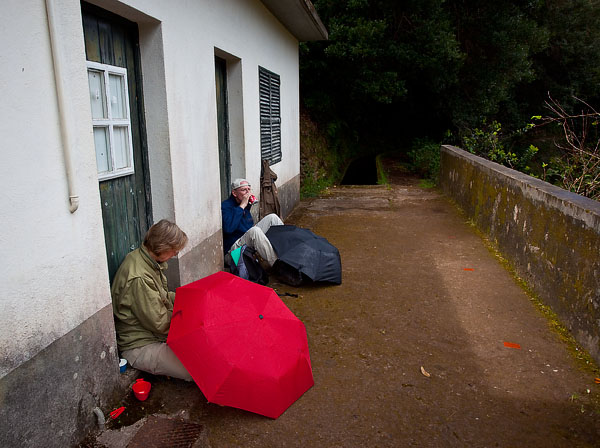
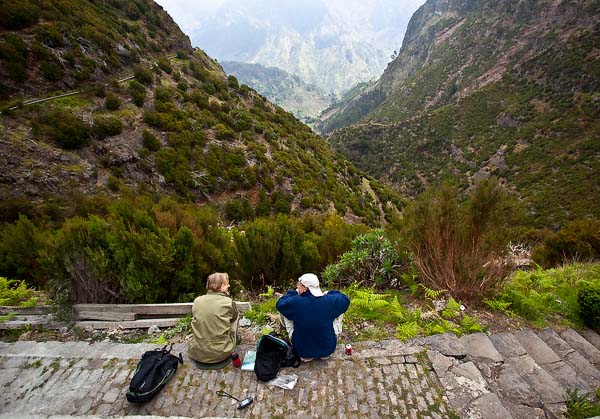
We have reached the levadeiro hut that clings to the mountainside and are occupying the two available seats. A short but heavy shower made us greatful for bringin the umbrellas in our backpacks, but here the sun is shining again. The levada runs under the terrace floor and continues in the dusk in the foliage in the background.

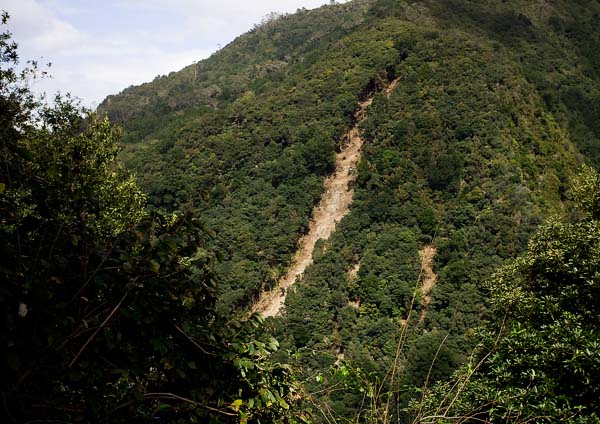
From the terrace we saw the tracks of a landslide. A large piece of land has simply let go and slid down the mountain. It has mown down everything in its way and left a string of bare mountain behind it.

Madeira 2010, day 2, Encumeada and Levada das Rabaçal

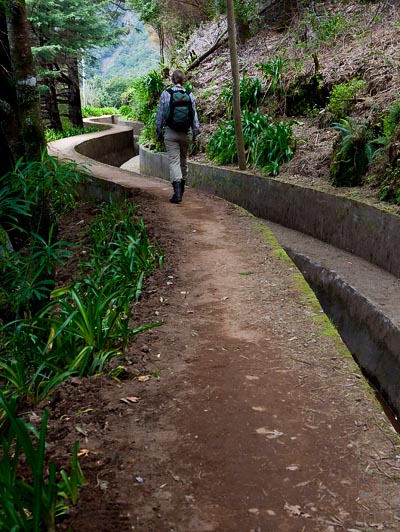
April 11. We started today’s levada walk at the Encumeada pass. The first part is a comfortable, wide path.

However, a few hundred meters further on, the path is closed with a sign. There have been quite a few landslides that have destroyed the levada and reconstruction work is going on. But it is Saturday and no Levadeiros are at work, so we decide to take the challange and continue along the Levada das Rabaçal that joins the Levada  Norte which we walked to start with.

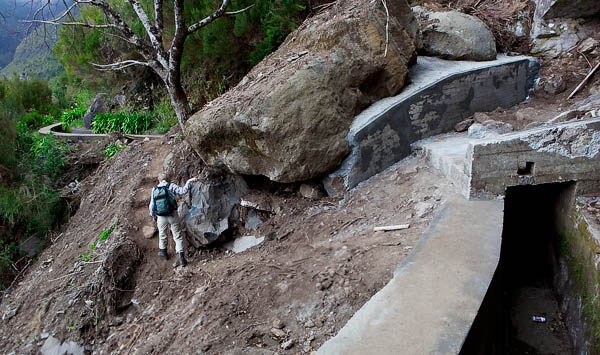
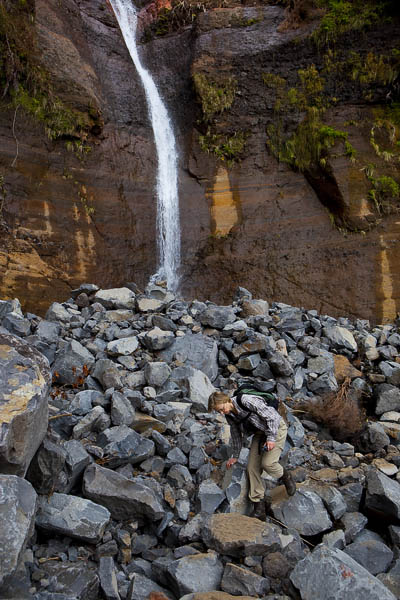
Being hit in the head with a stone of a fotball’s size is probably totally lethal. And yet, it feels like this rock could be even more dangerous. The Levaderio guys have secured the boulder with concrete to stop it from continuing its ravaging tour down to the valley several hundred meters below.

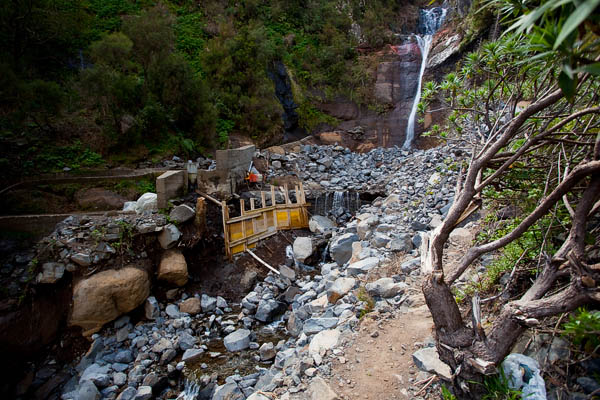
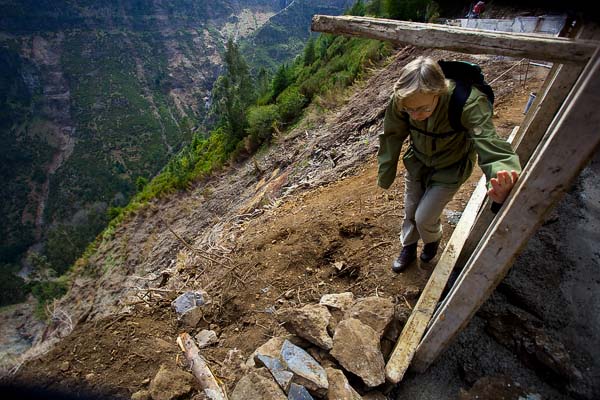
Here the levada is completely demolished by a heavy landslide. The Levadeiros who are reconstructing it have quite a lot of work to do. The wooden construction is a 2.5 meter high mould where they are starting to rebuild the levada section from scratch. The only way to get tools, a cement mixer, a diesel generator and cement here is to use a weelbarrow or just carry it.

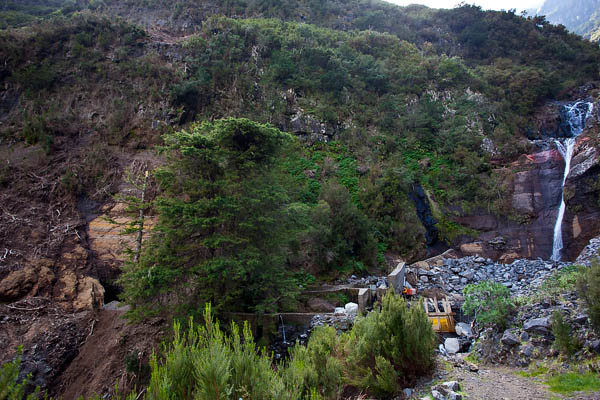
Here is a wider view. To the left you can see the entrance to a 300 meter long tunnel that takes the levada here from the other side of the mountain.

With some effort we managed to pass the landslide area.

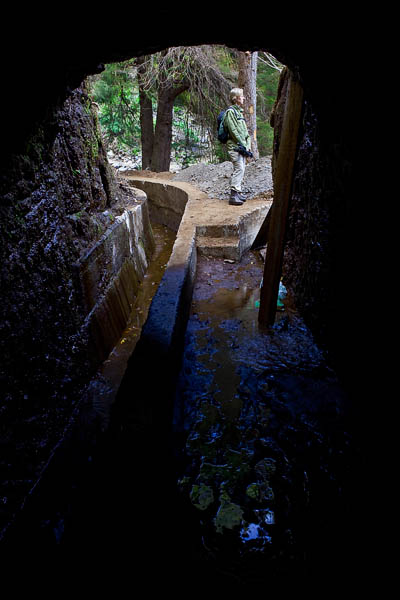
The tunnel from inside. It is often wet in the tunnel, so you need to use suitable shoeware. Keep a cap on to protect your head at least a little from being grazed, the tunnels are often low. And most of all, bring a good torch.

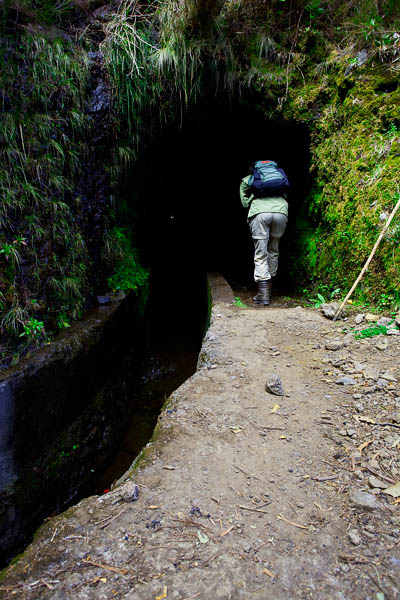
The tunnel from the other side. It is dead straight and if you look closely you can see the other entrance 300 meters away as a small light dot.

One mistake here and it will take a long time before you stop falling.

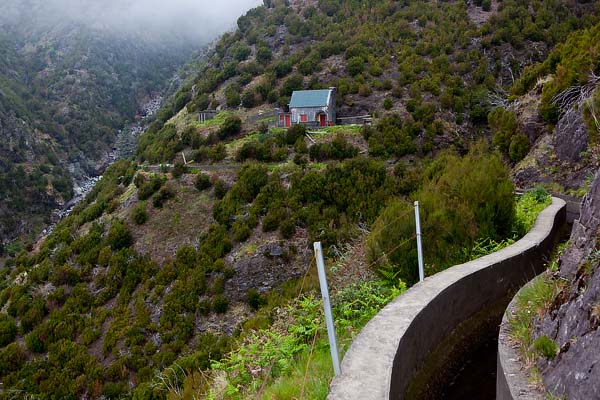
Eventually we can see our goal, the small Levadeiro cottage.

A well deserved break with a stunning view.

After the meal we turned back since the 2 km long tunnel that comes after the cottage was closed.

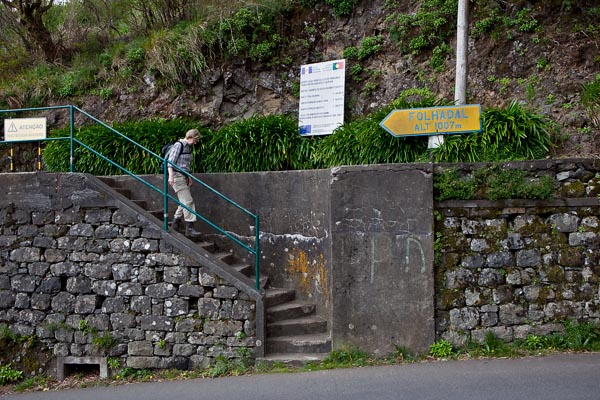
Back at the starting point we take the stairs down from the levada.

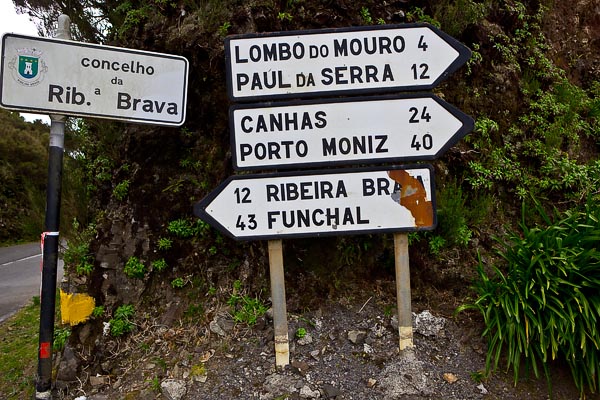
The Madeira roads mostly have good roadsigns to help you reach your goal. This is the crossway at the Encumeada pass. As the crow flies it is 35 km between Porto Moniz and Funchal. If you take the road over the mountains (come to think of it, all Madeira roads go over the mountains) it will be more than twice as long.